


Acrylic Edge Finishing Techniques Explained
The Crazing Problem That Nobody Saw Coming
Between 2020 and 2022, fabricators across the industry started getting warranty calls that didn't make sense. Display cases shipped in perfect condition were developing spider-web cracks along the edges. Two months after installation. Three months. The pattern was consistent: fine fractures spreading from flame-polished edges, always in healthcare facilities, schools, retail environments.
The cause took a while to pin down. On Signs101.com, one fabricator wrote: "We've done flame polished for years with no problems... All of a sudden the last 2 years the crazing has been really crazy, janitors have a bottle of 70/30 and tend to use it on everything."

Alcohol sanitizers. COVID had changed cleaning protocols everywhere, and acrylic edges that hadn't been annealed were failing on contact with isopropyl alcohol.
This wasn't a fringe issue. It reshaped how the entire industry thinks about edge finishing. What had been treated as a cosmetic step turned out to be a structural integrity decision with long-term consequences.
Cast Versus Extruded
Before getting into specific finishing methods, this distinction needs to be clear. It affects everything downstream.
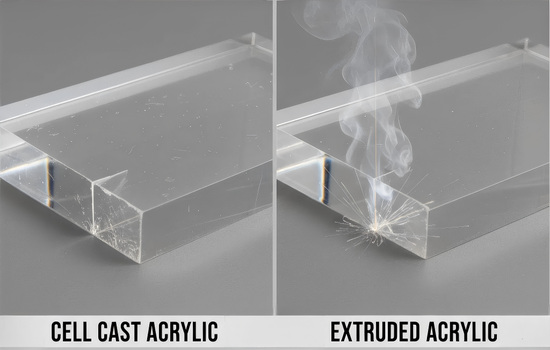
Cast Acrylic
Cast acrylic is made by pouring liquid monomer between glass plates and letting it polymerize. The molecular chains are longer. The material is more rigid. It machines cleanly-chips come off as distinct particles rather than melting back onto the tool.
Extruded Acrylic
Extruded acrylic gets pushed through heated dies. Shorter molecular chains. Different internal stress patterns. More prone to problems during and after processing.
A machinist on Practical Machinist described the difference this way: "Extruded acrylic is very difficult to machine nicely because it is not as rigid as cast acrylic, in addition it is very prone to stress cracking after machining and during polishing it is very easy to get the surface warm and initiate crazing."
But it's not as simple as "cast is better." Extruded material actually takes flame polishing more readily than cast. Cast requires more prep work-sanding, scraping-to achieve similar flame-polished results. A comment from Signs101 captures this: "Cast acrylic cuts smoother and doesn't melt as bad as extruded acrylic. Extruded acrylic flame polishes very nicely. Cast not nearly as well."
So material choice and finishing method need to be decided together. Running extruded through a CNC workflow optimized for cast will cause melting. Flame polishing cast without proper edge prep will leave visible marks. The material dictates the process, or the process dictates the material. Pick one approach and stay consistent.
Flame Polishing
Hydrogen-oxygen flame. Temperature somewhere around 1,850°C to 2,200°C depending on equipment. The flame melts the edge surface, which resolidifies smooth when it cools.
Speed is the main advantage. A 4×6 sign can be done in five minutes. Equipment costs are low-entry-level flame polishers run a few hundred dollars. For signage, simple displays, anything that won't be examined up close, the results are adequate.
The technique itself requires a bluish, nearly transparent flame about 75mm long, held at 45 degrees to the edge. Yellow flame means incomplete combustion; you'll deposit carbon and get a hazy finish. Movement needs to be quick-multiple fast passes work better than one slow pass. Slow movement builds too much heat in one area.
Thermal stress is the fundamental limitation. The rapid heat-cool cycle leaves residual tension in the edge material. That tension makes the edge vulnerable to environmental stress cracking when exposed to certain chemicals. Alcohol is the common culprit, but ammonia and acetone cause problems too.
The annealing fix is straightforward but adds time. Hold the finished piece at 82°C for one to two hours per 3mm of thickness. Cool slowly-two hours minimum for the cooldown. Skip this step and you're shipping a product that might craze in the field.
One more thing that catches people: flame polishing before gluing is a mistake. The thermal stress interacts badly with solvent cement penetration. Fractures develop around bond lines within weeks. The sequence that works is glue first, cure overnight, then flame polish the assembled piece.
Diamond Polishing
Automated equipment runs the workpiece edge against progressive diamond abrasive stages. Grit sequences vary by machine, but better equipment reaches 3,000 grit equivalent. Surface roughness after proper diamond polishing measures 18 to 25 RMS-approaching the clarity of the original sheet surface. Industry terminology sometimes calls this "museum quality" or "optical grade."
The mechanism is straightforward grinding and polishing, no different in principle from hand finishing but faster and more consistent. MCD (monocrystalline diamond) cutters produce the sharpest edges. PCD (polycrystalline) lasts longer but doesn't achieve quite the same clarity.

1,000 RPM
1mm - 120mm
No Stress
Equipment runs at about 1,000 RPM for standard 18-inch diameter wheels. Material thickness capacity ranges from 1mm up to 120mm depending on the machine configuration. A set of replacement cutters costs around £1,000. Full machine investment runs $30,000 to over $100,000 for industrial units.
Geometry is the constraint. Diamond polishing handles flat edges well. Bevels are fine. Complex curves, internal cutouts, tight radii-these need different approaches. For a fabrication workflow, diamond polishing covers the high-volume straight-edge work while other methods handle the exceptions.
No thermal stress issues with diamond polishing. No annealing required. Edges don't carry the same chemical vulnerability as flame-polished surfaces.
Laser Cutting Produces Its Own Edge Finish
CO2 lasers at appropriate power levels cut and polish in one operation. The relationship is roughly 8 to 15 watts per millimeter of material thickness. A 6mm sheet needs at least 60 watts. For 12mm, you want 100 watts or more.
Cast acrylic lasers cleaner than extruded. The edge comes out sharper, with less visible striation. Extruded tends to show linear marks following the beam path, sometimes a rougher texture from melting rather than clean vaporization.
The ACRYLITE technical documentation (acrylite.co) specifies minimum 40W for quarter-inch material, with 180W optimal for thicker stock. Kerf width runs 0.010 to 0.020 inches. Focus position matters-0.030 to 0.060 inches into the material typically produces the best edge quality.
Below about 12mm thickness in cast material, laser-cut edges are often good enough to ship without secondary finishing. Above that, or with extruded material, touch-up work is usually needed. Quick flame polish, or light sanding and buffing.
Laser cutting creates thermal stress similar to flame polishing. The same annealing requirements apply if the product will be exposed to aggressive cleaning chemicals.
Technical Specs
Kerf Width: 0.010 - 0.020 inches
Focus: 0.030 - 0.060 inches into material
Power (1/4"): Min 40W, Optimal 180W
CNC Routing Parameters
Most edge quality problems in CNC work come from incorrect parameters rather than equipment or material.
The melting problem shows up constantly on machinist forums. Material fuses to the cutter, edge comes out rough and clouded. Almost always, the spindle speed is too low or the feed rate is wrong.
> Minimum spindle speed: ~18,000 RPM
> Critical Threshold: Below 16,400 RPM causes melting
> Feed Rates (at 18k RPM): 75 to 300 IPM
> Target Chip Load: 0.001 to 0.004 inches per tooth
Tooling choice: single-flute O-geometry carbide end mills. The Onsrud 52-638 comes up repeatedly in forum discussions as a reliable choice. Never run cutters that have previously touched wood or MDF. Embedded particles contaminate the acrylic edge.
Cutting strategy affects results. Roughing passes with climb milling, then a full-depth finishing pass that removes just 0.02 inches. The finishing pass is what determines final edge quality.
CNCZone has a thread where someone asked about getting clean edges. The direct advice: "Use cast acrylic. Extruded will melt on your tools, cast will cut clean. With sharp cutters, you won't need coolant."
Routed edges need secondary finishing. The typical progression: 180 or 240 grit dry, 320 grit can go either way, 400 grit and finer must be wet. Water acts as coolant and lubricant; dry sanding above 400 grit generates too much friction heat and smears the surface instead of cutting it.
Full progression for show-quality edges: 180 → 320 → 400 → 600 → 800 → 1500 → buffing with appropriate compound.
Buffing Technique
Surface speed between 1,200 and 4,000 feet per minute. Soft flannel wheels should run toward the lower end. Wheel diameter typically 6 to 14 inches.
Compound matters. Blue rouge for initial cut, white compound for final finish. Apply tallow base first as a foundation for the compound.
Technique detail that prevents damaged workpieces: start buffing contact about one-third down from the top edge, not at the edge itself. Starting at the edge lets the wheel catch the workpiece and throw it.
Buffing works well for complex shapes. Curved surfaces, irregular edges, contoured profiles-the flexible wheel conforms to the workpiece geometry. With the right polishing compound, high gloss is achievable. The trade-off is speed. Buffing is slow, requires operator skill, and costs more per piece than automated methods. For high-end display stands and lighting fixtures where edge quality is critical, it remains a necessary step in the workflow.

Vapor Polishing (Limited Use)
Methylene chloride vapor dissolves the surface layer briefly, which resolidifies optically clear. Useful for complex internal geometries that other methods can't reach. Exposure time measured in seconds-three seconds maximum.
Major manufacturers including Evonik recommend against it. Methylene chloride is a probable carcinogen. Regulatory requirements are extensive. For general fabrication work, the technique is effectively obsolete.
The Crazing Prevention Protocol
Environmental stress cracking accounts for 15 to 25 percent of plastic failures generally, and over 40 percent for glassy polymers like PMMA. Small solvent molecules penetrate the polymer network, plasticize local regions, initiate microcracks that propagate into visible crazes.
Prevention comes down to three factors.
Material Selection
Use cast acrylic for applications involving chemical exposure risk. The higher molecular weight provides better resistance.
Stress Relief
Anneal after any thermal processing-flame polishing, laser cutting, thermoforming. Standard schedule is 82°C (180°F) for one hour per 3mm (⅛ inch) of thickness. Cool slowly. Two hours minimum for thin material, longer for thick stock.
Chemical Control
Mild soap and water for cleaning. No alcohol, ammonia, acetone on acrylic that hasn't been annealed. If annealing isn't practical, communicate the limitation to end users. Include cleaning instructions with the product.
The Sawmill Creek forum has a concise summary from someone who learned this through failures:
- (1) If you laser cut acrylic and did not anneal it, it will craze when alcohol is applied.
- (2) If you flame polished the edges, and did not anneal it, it will craze when alcohol is applied.
- (3) If you bought extruded acrylic, instead of cast, it will craze when alcohol is applied.
Choosing the Right Method
Signage mounted at height, viewed from distance
Flame polishing with annealing. Fast production, low cost, adequate quality for the application.
Retail displays, point-of-purchase units
Diamond polishing. The quality difference is visible. Edge clarity matters when customers are looking closely. Worth the higher equipment and processing cost.
Intricate designs, thin material, complex cutouts
Laser cutting, possibly with light touch-up. One operation handles cutting and finishing together.
Custom geometries with curves
CNC routing followed by hand finishing. Labor-intensive but necessary for shapes that automated equipment can't handle.
Medical applications
Diamond polishing on certified material with full traceability documentation. No vapor polishing due to solvent residue concerns. Edges must be burr-free and meet relevant biocompatibility standards.
Display racks, awards, decorative pieces
Diamond polishing. The result approaches the optical clarity of unprocessed sheet material. Equipment investment is significant, but batch production benefits from the consistency and throughput.
Large flat products like panels
Automated diamond polishing lines handle the volume.
Simple signage, products viewed from a distance
Flame polishing keeps costs down. With proper annealing, it meets the functional requirements.
Practical Lessons
Edge finishing decisions made in production affect product performance months later in the field. The alcohol-crazing episode demonstrated this clearly. So did every warranty claim from a flame-polished piece that wasn't annealed, every melted edge from wrong CNC parameters, every crazed bond line from incorrect processing sequence.
The specifics matter. Material type. Temperature control. Annealing schedules. Grit progressions. These aren't optional refinements. They determine whether products perform or fail in actual use.
Technical questions about edge finishing for specific applications can be directed to our engineering team.


