


Can Acrylic Raffle Box Prevent Tampering?
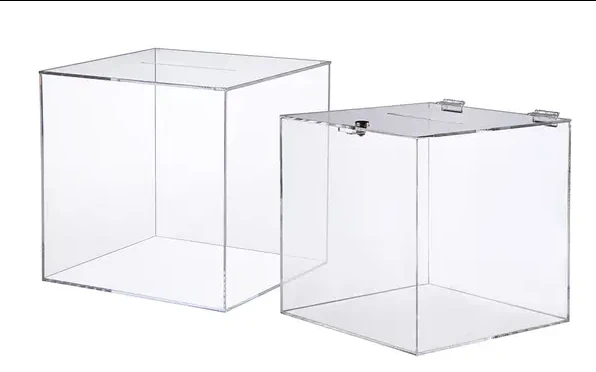
Acrylic raffle boxes provide substantial tampering protection through keyed locking mechanisms, narrow entry slots, and transparent construction that enables constant visual monitoring. The effectiveness depends on material thickness, lock quality, and proper deployment.
Most acrylic raffle boxes manufactured today use 4mm to 6mm cast acrylic material combined with keyed locks that create a multi-layered security approach. The transparent nature works as both a security feature and psychological deterrent-participants can verify the box hasn't been opened, while potential bad actors know their actions would be visible.
Material Properties That Resist Tampering
The physical characteristics of acrylic create the foundation for security. Cast acrylic sheets used in raffle boxes possess impact resistance roughly 17 times greater than standard glass of the same thickness. This isn't just about preventing breakage from accidents-it's about making forced entry significantly difficult without leaving obvious damage.
Typical raffle boxes use acrylic between 4mm and 6mm thick. At 4mm, the material provides adequate resistance for most fundraising and low-stakes events. When you move to 5mm or 6mm thickness, you're adding substantial resistance to tools like screwdrivers or prying attempts. A 6mm acrylic sheet requires approximately 3-4 times more force to penetrate than a 4mm sheet, though this increase comes with higher cost and weight.
The material's optical clarity-maintaining 92% light transmission even at 6mm thickness-means any tampering attempts like scratching, drilling, or stress marks become immediately visible. Someone trying to compromise the box can't hide their work. This visibility factor often proves more valuable than the physical strength itself, since most tampering occurs when perpetrators believe they won't be caught.
Acrylic's thermoplastic nature creates an interesting security characteristic. When someone attempts to drill or cut through it, the material generates visible stress whitening around the damage point. This whitening effect acts like a permanent record of tampering, making it impossible for someone to "test" an attack without leaving evidence.
How Locking Mechanisms Prevent Unauthorized Access
The lock represents the most critical security component. Most acrylic raffle boxes employ keyed cylinder locks rather than combination systems. This choice isn't random-keyed locks provide superior resistance to casual tampering while maintaining simple operation for authorized personnel.
Standard cylinder locks on raffle boxes typically use 4-pin or 5-pin tumbler systems. A basic 4-pin lock provides roughly 10,000 possible key combinations, while 5-pin locks jump to 100,000 combinations. For most charitable events and small-to-medium drawings, this level of security adequately prevents opportunistic tampering. Someone would need either the correct key, specialized lock-picking skills, or destructive entry methods that leave obvious evidence.
Higher-security applications-such as cash donations at large public events or high-value prize drawings-benefit from 6-pin or 7-pin locks. These systems can offer millions of unique combinations and include features like anti-pick pins that significantly increase the difficulty of unauthorized opening. Some manufacturers now offer tubular locks (often called "barrel locks") that provide enhanced pick resistance compared to traditional pin-tumbler designs.
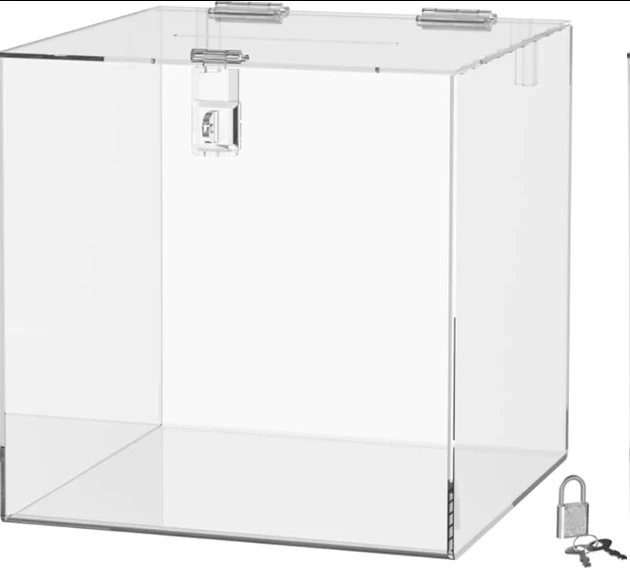
The physical placement of the lock matters considerably. Well-designed boxes position the lock mechanism where it's easily visible to observers but difficult to access with tampering tools. The lock should integrate flush with the acrylic surface rather than protruding, which eliminates leverage points someone might exploit with prying tools. Many quality boxes use hinged lids with the lock securing the hinge point, making it nearly impossible to access the interior without the key-even if someone managed to remove the entire lock assembly, the hinge wouldn't open.
Dual-key systems offer an additional layer of security for sensitive applications. In this setup, two different people hold keys, and both must be present to open the box. This arrangement works particularly well for political elections, high-stakes corporate votes, or substantial cash collections where accountability and trust are paramount.
Entry Slot Design as a Defensive Feature
The entry slot where people insert tickets or cash serves a dual purpose that many overlook. Yes, it needs to be large enough for entries to pass through easily. But its size and design directly impact security.
Most effective raffle box slots measure 145mm to 155mm in length and 6mm to 12mm in height. This dimension allows standard business cards, folded tickets, and even currency to enter smoothly, but the narrow height makes it extremely difficult for someone to insert tools or fingers to manipulate contents inside. A 6mm slot-roughly the thickness of four stacked quarters-provides enough clearance for entries while blocking access to anything more substantial.
The slot positioning on the top surface rather than a side panel makes gravitational security work in your favor. Entries fall away from the opening, settling at the bottom of the box. Even if someone attempted to fish for tickets with a thin tool, they'd need to work against gravity to lift items back toward the slot opening. The transparent walls of an acrylic raffle box let observers see if someone's spending unusual time hovering with their hands near the slot.
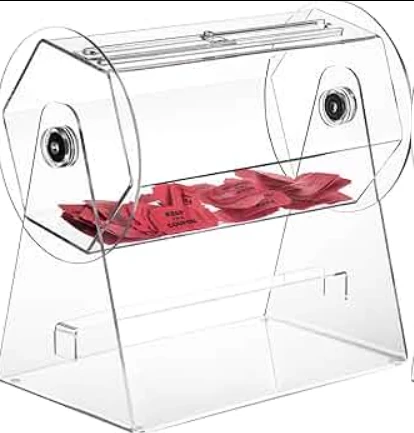
Some premium designs incorporate anti-fishing features like internal baffles or angled passages that create a "chicane" effect. Tickets can drop in easily, but retrieving them requires navigating multiple direction changes-essentially impossible through a 6mm slot with any improvised tool. Casino-grade raffle drums sometimes include spring-loaded flaps that open inward for entry but immediately close afterward, making extraction physically impossible without opening the locked access door.
The slot edges matter too. Quality manufacturers polish and slightly round the slot edges to prevent paper jams while ensuring there are no gaps between the slot and the main body. Any gap, even 1-2mm, could provide purchase for a prying tool. The slot should be precision-cut or laser-finished, not simply drilled, to maintain tight tolerances.
Transparency as Active Security
Clear acrylic creates what security professionals call "transparent accountability"-the ability for anyone to verify the system's integrity at a glance. This might be the most powerful anti-tamper feature.
When a raffle box is transparent, participants can see the tickets accumulating inside throughout the event. This visibility serves multiple security functions. First, it provides immediate detection of any unauthorized opening-if the box was secretly accessed and tickets removed, the visible reduction in contents would be noticed. Second, it eliminates concerns about "setup" or pre-filled boxes, as everyone can verify the container starts empty. Third, it creates social pressure against tampering since bad actors know dozens or hundreds of people have visual memory of the box's contents at various times.
The psychological deterrent effect is substantial. Studies in retail security show that transparent containers reduce theft by 60-70% compared to opaque alternatives, even when actual monitoring remains constant. People behave differently when they know their actions are visible. For raffle organizers, this means an acrylic raffle box with transparent construction provides security benefits beyond what the physical lock delivers.
However, transparency creates a privacy consideration for certain applications. Ballot boxes for elections or sensitive workplace surveys may require opaque or frosted acrylic to protect voter anonymity. In these cases, security depends more heavily on the lock quality and tamper-evident seals, since visual monitoring of contents isn't possible or desired.
Common Acrylic Raffle Box Vulnerabilities and Solutions
No security system is perfect. Understanding where acrylic raffle boxes face the greatest tampering risks helps you select appropriate models and use them correctly.
Slot Opening Attacks: The entry slot represents the most accessible attack surface. While standard slots resist casual fishing attempts, a determined person with thin, rigid wire tools might extract tickets-especially if the box contains few entries and tickets rest near the top. The solution lies in using boxes with internal baffles or ensuring boxes are emptied regularly when ticket volume is low. For very high-security needs, boxes with closeable/lockable slots exist, though they require an attendant to open the slot for each entry.
Lock Quality Variations: Not all locks are created equal. Budget raffle boxes ($15-30 range) often use simple 3-pin or 4-pin locks that someone with basic lock-picking knowledge could open in 30-60 seconds. Premium boxes ($50-100+) typically feature 5-pin or tubular locks requiring specialized tools and skills. For events handling significant cash or high-value prizes, investing in better lock quality pays off. Look for locks from reputable manufacturers like Medeco, Ace, or Master Lock rather than generic Asian imports.
Material Thickness Compromises: Manufacturers sometimes reduce acrylic thickness to cut costs. A 3mm box might look identical to a 5mm box but offers substantially less tamper resistance. When purchasing, verify the actual thickness specification-it should be clearly stated. For reference, 4mm is minimum acceptable for general use, 5mm is standard for professional applications, and 6mm+ is appropriate for high-security needs.
Base Attachment Vulnerabilities: Some lower-quality boxes attach the base with just adhesive rather than mechanical fasteners or welding. A person could potentially pry off the base plate to access contents from beneath. Quality boxes either use a single-piece molded design (no separate base) or secure the base with metal screws in addition to adhesive. Check this before purchase-turn the box over and look for screw heads or verify it's molded as one piece.
Hinged Access Design Flaws: Boxes with hinged lids must secure both the hinge and the lock point. Some cheaper designs only lock the lid's front edge, leaving the hinged rear edge vulnerable to prying. Proper designs either use continuous hinges that can't be disassembled without tools, or place the lock mechanism at the hinge point itself, making it impossible to separate the hinge without the key.
Situational Security: Matching Your Acrylic Raffle Box to Event Type
Different events demand different security levels. A school fundraiser collecting $5 raffle tickets requires different protection than a casino drawing $100,000 cash prize.
For low-stakes community events-school bake sales, church fundraisers, local business promotions-a standard acrylic box with 4mm walls and a basic keyed lock provides adequate security. The transparency and lock presence mainly serve to prevent opportunistic spur-of-the-moment tampering. At this scale, the social environment (people around) and low stakes make sophisticated attacks unlikely.
Medium-stakes scenarios like corporate raffles, charity galas, or sports club drawings benefit from enhanced security: 5mm acrylic thickness, 5-pin keyed locks, and ideally dual-key control where two officers must be present to open the box. For events collecting substantial cash donations, consider boxes with separate compartments or using multiple boxes to limit loss if one were somehow compromised.
High-stakes applications-political elections, union votes, large-scale fundraisers handling tens of thousands in cash-require maximum security measures: 6mm+ acrylic, high-security tubular or 6-pin locks, dual-key systems, internal baffles, and possibly even tamper-evident security seals that must be broken to open the box. At this level, you're also implementing procedural security: multiple witnesses for any opening, video surveillance of the box's location, and documented chain of custody.
The physical environment matters greatly. A box placed in a busy, well-lit lobby with constant foot traffic gains substantial security from environmental monitoring. That same box left in a quiet hallway with intermittent traffic faces much higher risk. When possible, position raffle boxes in high-visibility locations where natural surveillance occurs. If that's not feasible, consider video camera coverage or frequent physical monitoring by staff.
Best Practices for Maximum Security
Beyond the box itself, deployment practices dramatically affect security effectiveness.
Document the starting state: Before your event, photograph the empty box from multiple angles, showing the lock intact and contents clearly empty. Take additional photos after the first few entries. This documentation proves the box's starting condition and makes it much harder for someone to claim the drawing was "rigged" or tampered with before the event.
Maintain line-of-sight supervision: Whenever possible, keep the box within visual range of staff or volunteers. You don't need constant staring, but periodic glances every few minutes create accountability. Position the box so staff at a registration desk, check-out counter, or information table can naturally monitor it while doing other tasks.
Use numbered tamper-evident seals: For high-security situations, apply numbered security tape or seals across the lock or access points after setup. These seals leave obvious evidence if someone removes them, and the numbering lets you verify the same seal remains in place from start to finish. Document the seal number in your photos. Industrial tamper-evident security seals cost $5-15 and provide substantial assurance.
Implement dual-custody protocols: For cash or high-value situations, require two authorized people to be present whenever the box is opened. This simple procedure eliminates the possibility of solo tampering and ensures accountability. Both individuals should sign documentation noting the date, time, and reason for each opening.
Empty at reasonable intervals: Don't let cash or extremely high volumes of tickets accumulate. If you're collecting significant cash donations, empty the box every 2-3 hours into a secured location with a deposit log. This limits potential loss from any security breach and reduces the temptation for bad actors.
Secure the box itself: In busy public environments, consider physically securing the box to a table or counter using a security cable or bolt. While this doesn't prevent tampering with the box itself, it eliminates the possibility of someone simply walking away with the entire container. Cable locks work well for temporary installations, while bolt-mount systems suit permanent or long-term placements. This physical anchoring is especially important for acrylic raffle boxes in high-traffic areas like shopping malls or convention centers.
When Your Acrylic Raffle Box Needs an Upgrade
Certain situations require security beyond what standard acrylic boxes provide.
Government elections and union representation votes often face legal requirements that exceed commercial raffle box capabilities. Many jurisdictions mandate specific certifications, sequential numbering systems, or even metal construction for official voting. In these cases, acrylic boxes might serve for preliminary straw polls or preference surveys but wouldn't meet legal standards for binding votes.
Large-scale cash collections-think major charity drives collecting donations at crowded public events-may need more robust solutions. Metal ballot boxes with deposit slots (similar to bank night deposit boxes) provide substantially greater physical security than acrylic. These commercial-grade units typically use 12-gauge or 14-gauge steel construction with high-security locks, making forced entry require power tools and significant time.
Casino and gaming applications require completely different standards. Regulated gaming environments must use equipment meeting specific certifications like ANSI/SIT standards for tamper resistance. These professional systems often incorporate electronic monitoring, multiple lock systems requiring different keys, and designs approved by gaming control boards. A standard acrylic raffle box wouldn't meet these requirements.
For situations where acrylic's limitations become clear, consider whether you actually need a different container or whether you need to improve the processes around the container. Many "security" problems are actually procedural problems. If you're concerned about tampering, adding video surveillance, increasing monitoring frequency, or implementing better documentation might address the concern more effectively than switching to a metal box.
Material Longevity and Security Degradation
Acrylic's security effectiveness changes over time. Unlike metal boxes that primarily degrade through rust or dent damage, acrylic faces different longevity challenges.
UV exposure causes acrylic to yellow and become brittle over years of outdoor use. While UV-stabilized acrylic resists this degradation better than standard formulations, even quality material will show effects after 5-7 years of direct sunlight exposure. Brittle acrylic becomes more vulnerable to cracking and breaking, reducing its tamper resistance. Indoor use largely eliminates UV concerns, but check any boxes used outdoors annually for yellowing or surface crazing (fine crack networks).
Scratches and abrasions accumulate with repeated use and cleaning. Surface scratches don't significantly affect security, but they do reduce transparency-making visual monitoring less effective. Deep scratches or gouges can create stress concentration points where the material becomes more likely to crack if impacted. Inspect boxes regularly and replace any showing significant surface damage.
Lock mechanisms wear over time. Repeated use gradually loosens the tolerances in pin-tumbler locks, potentially making them easier to pick or allowing dust and debris to interfere with operation. Lubricate locks annually with graphite powder (not oil, which attracts dirt). If a lock begins sticking or the key becomes difficult to turn, consider replacing the lock cylinder before it fails during an event.
The adhesive bonds securing bases or attachment points can degrade, especially with temperature cycling or exposure to cleaning chemicals. Annually check all glued joints by gently attempting to flex them-they should show no movement. If you detect looseness, either reinforce with appropriate acrylic cement or retire the box before the joint fails.
With reasonable care, a quality acrylic raffle box should provide reliable security for 5-10 years in indoor applications or 3-5 years in outdoor/high-UV environments. Budget boxes might only deliver 2-3 years before showing significant wear. Factor replacement costs into your long-term planning.
Frequently Asked Questions
Can someone break an acrylic raffle box to get inside?
Breaking is possible but impractical in most scenarios. A 5mm acrylic box requires significant force-similar to breaking a car side window. The attempt would be loud, create obvious damage, and take 10-30 seconds of repeated impacts. The transparent construction means anyone nearby would see the attack in progress. For outdoor or unsupervised locations, this remains a vulnerability, which is why proper positioning in visible, monitored areas matters significantly.
How do I know if someone picked the lock?
Professional lock picking rarely leaves obvious evidence, but most raffle box locks have quality levels that make picking difficult and time-consuming enough that surveillance or witness presence becomes the primary deterrent. For very high-security needs, consider using tamper-evident security seals that cover the lock mechanism-they show immediate visual evidence if disturbed. Some organizations also photograph the lock and seal configuration before events, documenting the untampered state.
Are clear boxes secure for secret ballots?
Transparent boxes compromise ballot secrecy since tickets or papers are visible inside. For elections or confidential surveys, use frosted or opaque acrylic that blocks content visibility while maintaining the material's tamper-resistant properties. The trade-off is losing the psychological security benefit of transparent monitoring, so lock quality and procedural controls become more important.
What slot size prevents ticket fishing?
Slots 6mm to 10mm in height effectively prevent retrieval tools from accessing contents. Entries can drop through easily, but fingers and most improvised tools won't fit or won't be able to grasp and lift tickets back out. Wider slots (15mm+) become vulnerable to thin wire loops or hooks. If you must use a larger slot for special materials, look for boxes with internal baffles or anti-fishing designs that create obstacles between the slot and the main collection area.
The Right Box for Your Needs
Selecting a raffle box ultimately comes down to matching security features to your actual risk level. A $20 basic box with 4mm acrylic and a simple lock handles low-stakes fundraisers perfectly well. Stepping up to $50-80 gets you 5mm construction, better locks, and features like internal baffles that significantly improve security for medium-stakes events. Premium boxes at $100+ deliver 6mm or thicker acrylic, high-security locks, and specialized features justified only for high-value or legally regulated applications.
The most secure box won't help if deployed poorly, while even a basic box provides substantial protection when used with good procedures-proper positioning, regular monitoring, documentation, and appropriate protocols. For most organizers, investing in better deployment practices offers more security value than investing in maximum-spec equipment.
Acrylic raffle boxes effectively prevent tampering for the vast majority of real-world applications. The combination of transparent construction, keyed locks, and narrow entry slots creates multiple barriers to interference. Understanding the system's strengths and limitations helps you select appropriate equipment and use it effectively, ensuring your drawing remains fair, secure, and trustworthy.


