


Acrylic Thickness Guide for Different Applications
I get asked about thickness more than anything else. People overthink it sometimes, underthink it other times. Here's what actually matters after twenty-some years of cutting this stuff.
The Basics
Cast and extruded aren't the same. Extruded runs thinner than nominal. A sheet marked 1/4" might mic out at .220 or so. Cast holds tighter tolerances. This matters if you're doing precision work or stacking pieces.
Standard stock from most distributors:
1/8" (actually around .118" extruded, closer to .125" cast)
3/16"
1/4"
3/8"
1/2"
3/4"
1"
Plaskolite, Evonik, Trinseo all run slightly different. I've seen 1/4" Optix come in at .236" and Acrylite at .243" from the same order. Keep a caliper handy.
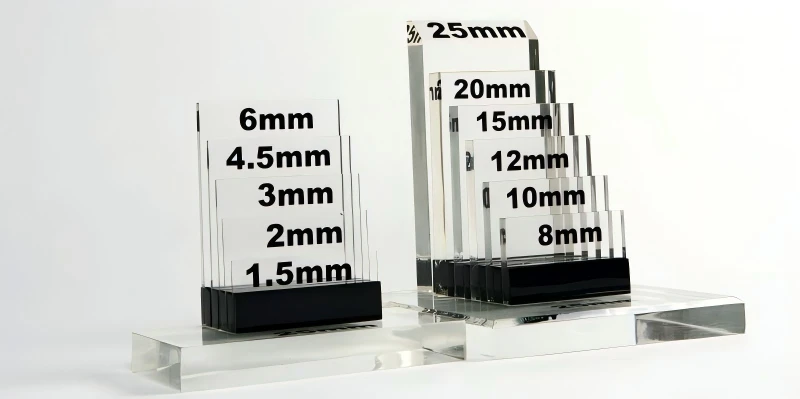
Thin Stock: 1/8" and Under
Eighth-inch is the workhorse. Photo frames, basic POP displays, that kind of thing. Cheap, easy to work. You can score and snap it clean if your blade is fresh and you're not trying to do curves.
The 1/16" and .060" sheets exist but I don't stock them anymore. Too flimsy for most jobs. They scratch during handling. Customers return them bent. Not worth the headache unless someone specifically needs film-type material.
One thing about 1/8" - it shows deflection fast. Anything wider than maybe 10-12 inches unsupported, you'll see bow. Put a brochure holder on a trade show table made from 1/8" with a 16" span, it sags in the middle by end of day one. Seen it happen plenty of times.
The 1/4" Sweet Spot
This is probably 60% of what we sell. Sneeze guards, display cases, smaller signs. It handles most jobs.
Cutting gets a little trickier here. You can still score-and-snap if you're good, but I'd say skip it. Circular saw with a triple-chip blade, 80 tooth minimum. Slow feed rate. The edge comes out decent enough to flame polish or just sand with 400 grit.
For span, figure 18-20 inches max without support if it's just sitting there. Put weight on it and cut that in half. I had a guy want a 24" wide shelf in 1/4" for his retail case. Told him it would sag with product on it. He insisted. Called me three weeks later asking why his watches were sliding to the middle. Should've gone 3/8" or added a center support.
3/8" Territory
This is where material cost starts climbing. A 48x96 sheet in 3/8" runs something like twice what 1/4" costs, maybe more depending on supplier and whether it's cast.
The weight picks up too. A full sheet in 3/8" is around 35 pounds. Two-person lift.
But for anything structural, this is usually minimum. Machine guards, window replacements, barriers that might take an impact. Sneeze guards in high traffic spots where carts bump into them.
Drilling 3/8" takes some care. Standard twist bits grab and crack it. Either use a bit ground for plastics or go slow with light pressure and backing board. Pilot holes help. I've cracked plenty of pieces by rushing.

Half-Inch and Up
Here's where I tell people to really think about whether they need it. Half-inch acrylic is heavy. A 48x96 sheet weighs close to 50 pounds. Your shipping costs jump. If you're laser cutting, most CO2 machines tap out around this thickness.
That said, half-inch is great for tabletops, desktop protectors, heavier shelving. It machines well, edges polish up nice, and it looks substantial.
Three-quarter and one-inch - now you're in furniture and architectural territory. Conference tables, museum pedestals, high-end retail. The material cost is significant. A 1" cast sheet can run four or five hundred dollars depending on size. Finishing the edges takes time. Polishing a 1" edge to optical clarity is not a quick job.
I've done pieces up to 2" thick for a few projects. Trophy bases, a hotel lobby installation. Lead time on anything over 1" is usually longer. Not everyone stocks it.
Real World Span Numbers
Everyone wants a chart. Problem is, it depends on too many variables. Cast or extruded. Cell cast or continuous cast. Temperature in the install location. How much load. Static or dynamic. Edge support method.
Rough rules I use:
For shelves holding lightweight stuff - picture frames, small collectibles - you can push 1/4" out to maybe 24" if it's got full edge support on both ends and nothing heavy in the middle. I'd still rather see 3/8" for that span.
For anything taking real weight, half-inch at 24" max. Even then, add a center support if you can.
Outdoor signs in wind load areas - go up a size from whatever you'd use indoors. I put up a 1/4" sign for a client in a strip mall corridor. Thought it was protected. Wind tunnel effect between buildings. Sign was flapping, pulled out of the standoffs in two months. Replaced it with 3/8", no problems since.
Outdoor Considerations
UV degradation happens regardless of thickness. Standard acrylic yellows and crazes eventually. Specify UV-stabilized or use a product like Acrylite OP-4 if it's going outside. Costs more but lasts.
Thermal expansion is real. Acrylic moves more than glass. A 96" piece can grow or shrink a quarter inch across temperature swings. Leave room in your frames. I've seen panels buckle in summer heat because the fabricator mounted them too tight.
Fabrication Notes
Laser cutting - most 40-60 watt hobby machines max out around 1/4". Even then, you're running multiple passes. Industrial lasers handle 1/2" fine. Above that, waterjet or CNC routing.
Bending - 1/8" bends easy with a strip heater. Give it a few minutes, it goes soft, you form it, done. Quarter-inch takes longer, maybe twice the heat time. By the time you're at half-inch, you're looking at oven heating or commercial forming equipment. Not really a DIY situation.
Cementing - thickness doesn't change the process much, but thick pieces hold more solvent and take longer to cure. Don't rush it. I've had 3/4" joints that looked solid but were still soft internally because they only cured 24 hours. Give thick joints a few days minimum.

What I Actually Recommend
Point-of-purchase displays, indoor signs: 1/8" to 1/4", depending on size
Sneeze guards, counter shields: 1/4" for small ones, 3/8" for anything over 24" wide or in high-traffic areas
Display cases: 1/4" for small stuff, 3/8" for full-size retail cases, 1/2" if the panels are tall
Shelving: 3/8" minimum for anything over 12" span with load on it, 1/2" for heavy items or long spans
Tabletops: 1/2" for occasional use, 3/4" for daily use furniture
Outdoor signs: Start at 3/16" for small protected locations, 1/4" to 3/8" for most situations, 1/2" for large or exposed areas
If someone's unsure, I'd rather they go a little thicker than save a few bucks and have it fail. But I've also seen people spec 1" for jobs that needed 1/4". Waste of money and makes the piece heavier than it needs to be.
Pricing Reality
Don't assume double thickness means double price. It's more like 1.8 to 2.2 times, and it varies by supplier and sheet size. Quotes change month to month. Freight matters more on thick sheets because of weight.
Cast costs more than extruded in every thickness. Worth it for polished edges or optical quality applications. Not always necessary for painted or covered pieces.
Get quotes on your actual sizes. A 24x36 piece might come from waste on a larger sheet if the distributor is cutting that day. Sometimes you luck out.
Thickness choice comes down to span, load, and environment. Most jobs land somewhere between 1/4" and 1/2". When in doubt, ask supplier - they've probably seen your exact application before.


