


Why Do Anime Fans Love Laser Engraved Acrylic Gifts?
Exploring the phenomenon of custom laser-engraved acrylic merchandise and why it has captured the hearts of anime enthusiasts worldwide.
My sister spent $85 on a piece of plastic last month. Not a figure. Not a signed print. A laser-cut acrylic standee of some white-haired anime guy I didn't recognize.
I thought she'd been scammed until she plugged it in.

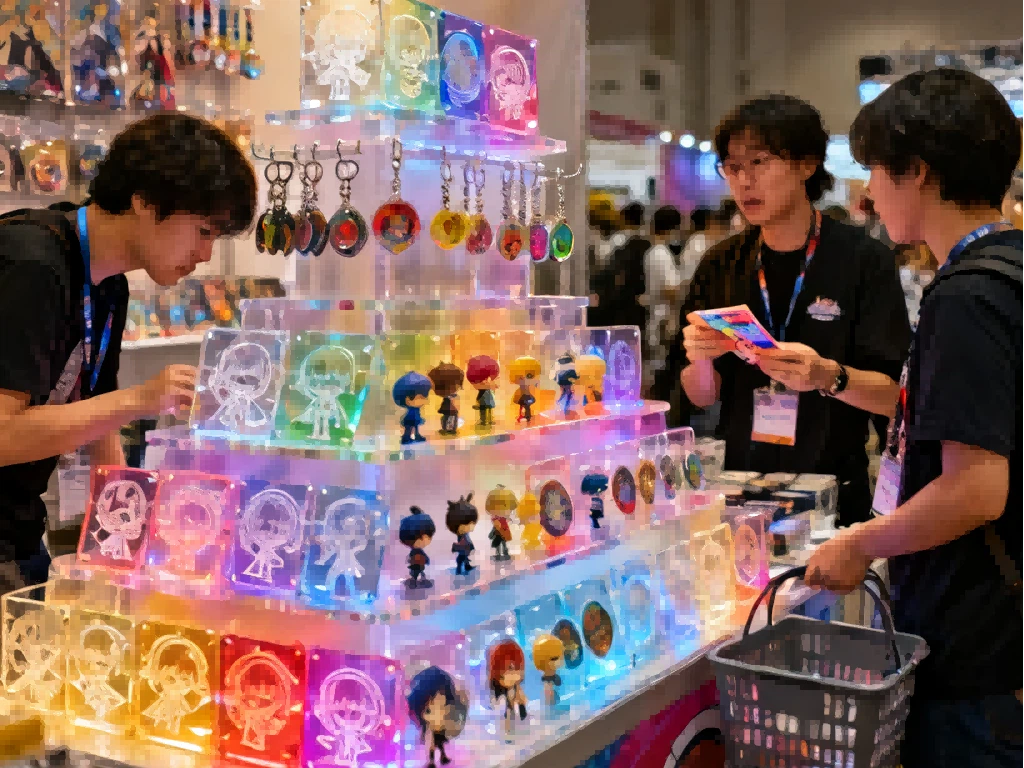
Photo: Convention vendor booth, Anime Expo 2024 - note the crowd
Look, I'm not an anime person. But my editor saw me staring at this glowing thing on my sister's shelf and said "there's a story there." He was right, but not for the reasons I expected.
How This Even Started
Marcus Chen runs a booth at conventions. Has been since-I want to say 2016? Maybe 2015. We met at his workshop in Jersey City (I took NJ Transit, it was a whole thing), and the first thing you notice is the noise. Like, constant humming from maybe twenty laser cutters running at once.
"You want coffee?" he asks. "It's not great but it's hot."
We sit. I ask him the obvious question: when did anime fans start caring about laser engraving?
He laughs. "They didn't, at first. Japanese companies were already doing acrylic stands, right? But you could only get them at Animate stores in Japan or through proxy shipping services. Which meant paying like $40 for the item plus another $30 in shipping and fees."
Someone on Etsy figured out they could make similar products cheaper. Then someone else. Then it became a thing.
"Now the official companies are copying the bootleggers," Chen says. "It's backwards."
I looked this up later-he's right. Good Smile Company's recent acrylic stand lines look identical to fan-made stuff from 2018. The market basically forced official merchandisers to adapt.
The Technical Thing I Still Don't Fully Understand
Lisa Rodriguez works in LA doing production management for a merch company. She's also spent 15 years watching One Piece, which she insists matters for this conversation.
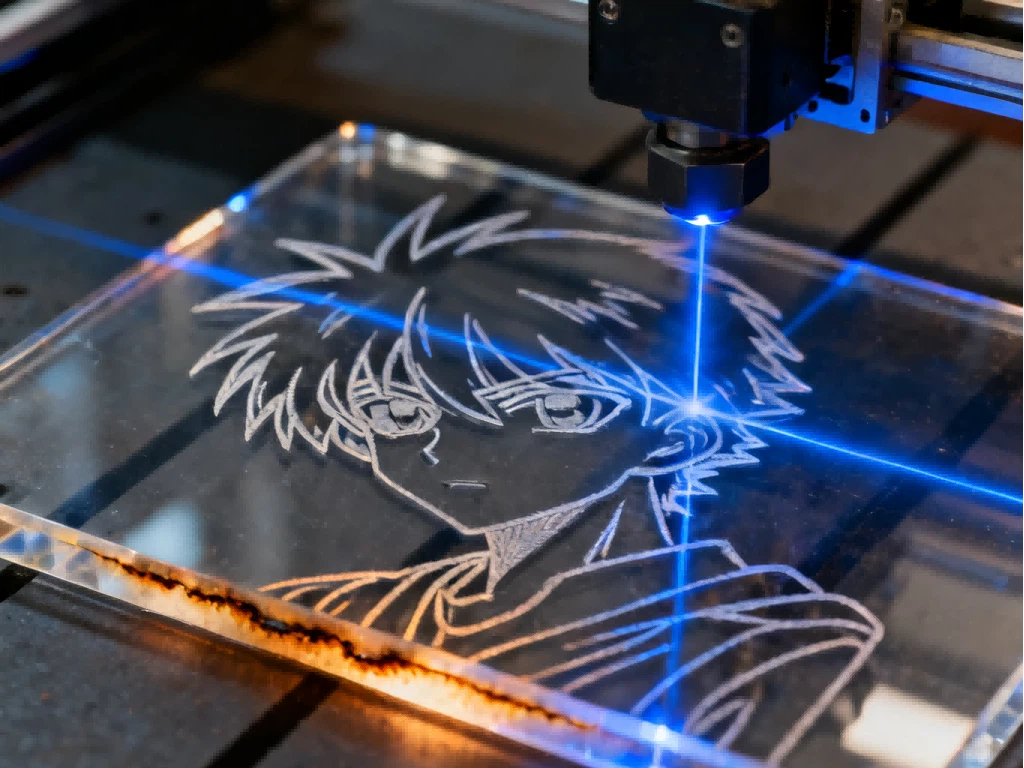
"Laser engraving is basically controlled destruction," she tells me over Zoom. Her background is cluttered with anime figures and I can see at least three acrylic pieces catching light from her window.
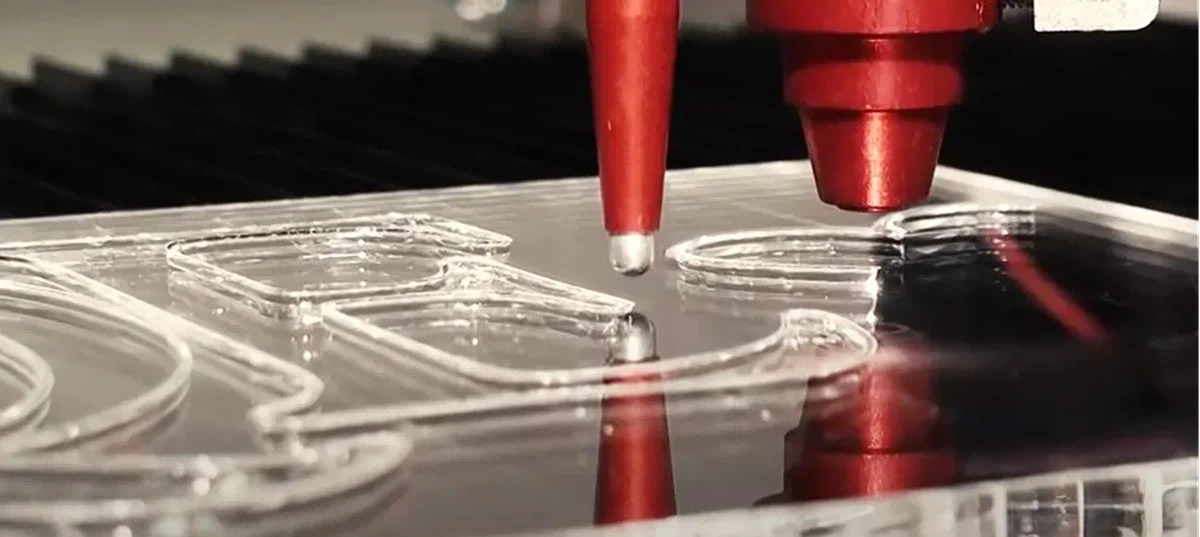
The laser-usually CO2, she says, 40 to 100 watts depending-vaporizes the top layer of acrylic at specific depths. Too shallow and you get nothing. Too deep and the whole thing cracks.
She shows me her screen. It's a Photoshop file with like six different layers of the same character. "Each layer is a different depth setting. You're essentially carving shadows into plastic."
"How long did it take you to figure this out?" I ask.
"Honestly? I'm still figuring it out. Different acrylic colors react differently. Cast acrylic versus extruded acrylic-they're not the same. Last week I trashed a $60 piece because I forgot to adjust for the thickness."
She pulls up a photo of a failed Demon Slayer print where half of the character's face is just... gone.
"Ten hours," she says. "Ten hours of work. Trash."
Wait, Why Do They Glow Though?
I'm embarrassed to admit I didn't know this going in. I assumed it was some kind of phosphorescent material or LED strips embedded in the acrylic itself.Nope.
The Science Behind the Glow
James Park-engineer, part-time acrylic artist, full-time Gundam obsessive-explains it to me. "The laser creates microscopic fractures in the acrylic. When light hits those fractures from the LED base, it scatters. The engraved parts light up, the clear parts stay clear."
"So it's just breaking the plastic in the right way?"
"Pretty much, yeah."

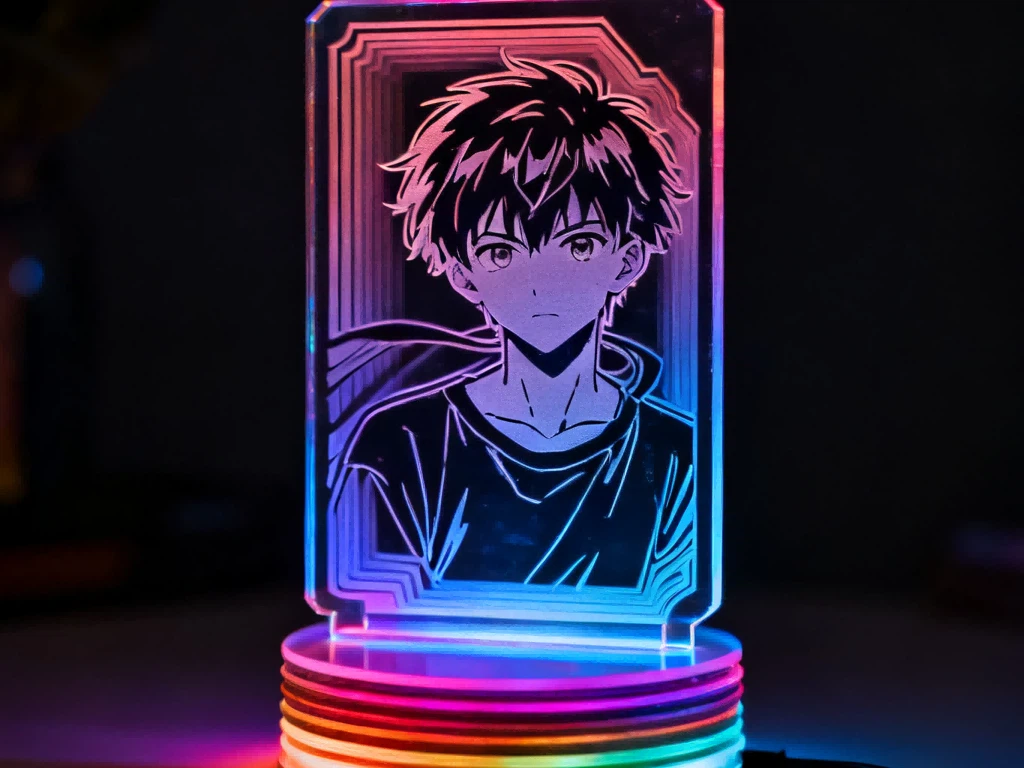
I've now seen this effect probably thirty times while reporting this piece and it still gets me. There's something weirdly magical about watching a flat image suddenly pop into three-dimensional glowing life when someone turns off the lights.
My sister was right to buy that thing. I'm still not admitting this to her.
Custom Everything (This Is Actually The Whole Point)
Here's what I kept hearing from fans, and I talked to a LOT of them:
"There's no official merch of my favorite ship."
This was Alex T. in Baltimore. She collects Haikyuu stuff-has about forty acrylic pieces on a wall-mounted shelf system that probably cost more than the pieces themselves.
"The characters exist separately in official merch but not together how I want them," she explains, showing me photos. "Like, these two are canonically teammates but I ship them. The company's never making that. So I commissioned it."
She's spent maybe $2,000 on custom pieces over two years. Each one is a specific pairing or scene that doesn't exist in official capacity.
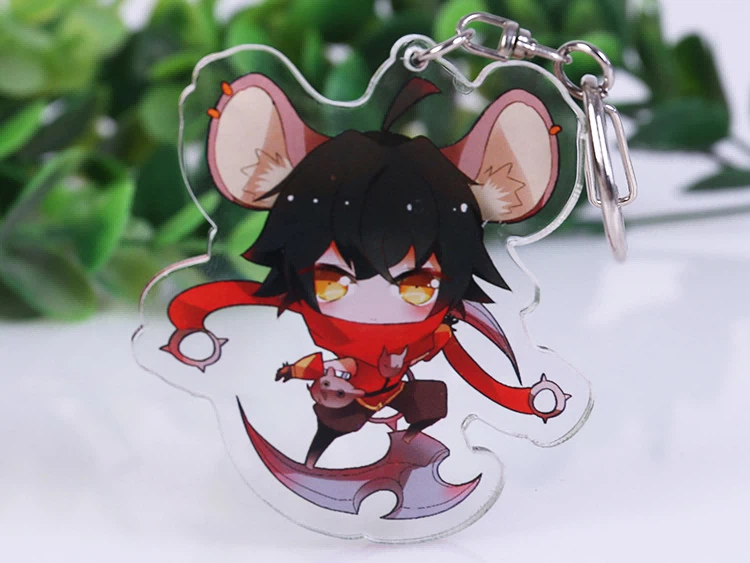

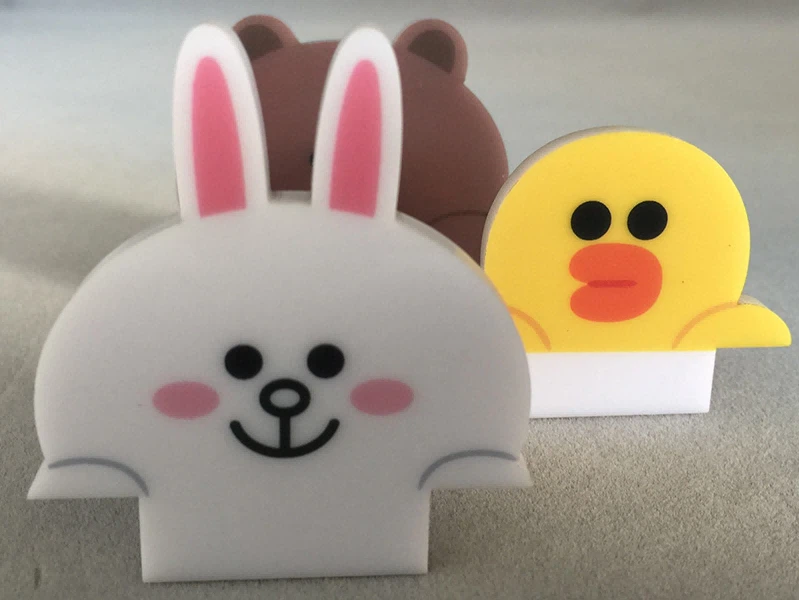
And this is the thing I kept hearing: laser engraved acrylic gifts fill gaps in the market that official merchandise ignores. Your favorite background character who never got a figure? You can have an acrylic standee. Your D&D character drawn in anime style? Same. That one manga panel that hit different? Absolutely.
"I have merch of my OC standing with canon characters," another collector told me. "Where else can I get that?"
The Business Side (It's Messy)
Jennifer Wu tracks manufacturing trends in pop culture merchandise. She sent me a report from IDTechEx showing the custom laser-engraved gifts market grew about 340% between 2019 and 2024.
I called her to verify because that number seemed insane.
"It's accurate," she says. "What happened is the barrier to entry dropped significantly. You can get a decent laser cutter for $2,000 to $3,000 now. Five years ago? Double that, minimum."
So people bought cutters, opened Etsy shops, started making anime merch. Some of them are pulling five figures monthly. Others already quit.
Custom Laser-Engraved Gifts Market Growth

"The market's saturated," Wu says. "When everyone's selling similar quality at similar prices, you're just competing on speed and customer service. That's hard."
I asked Chen about this-the Jersey City guy with all the laser cutters.
"Yeah it's competitive. But-" he pauses, watching one of his machines work. "People who do actual quality work? They're fine. The ones struggling are folks who thought this was passive income."
I Bought Five To Test This
Because I'm a journalist and also curious, I ordered five different laser engraved acrylic pieces from five sellers. Price range: $18 to $75. Same character (Gojo Satoru-I learned who this is), roughly same size.
The $18 One
The $18 one is garbage. Visible bubbles in the acrylic. The engraving is so shallow I can barely see it even with the LED on. It arrived in a bubble mailer with no protection and I'm honestly surprised it survived shipping.
★☆☆☆☆ 1/5
The $75 One
The $75 one is perfect. Like, museum-quality perfect. Crystal clear acrylic, engraving depth is exactly right, it came in a custom foam box with a spare LED base and a thank-you note.
★★★★★ 5/5
The three middle options ranged from "fine I guess" to "pretty good."
"You get what you pay for," Rodriguez tells me when I describe this. "A lot of sellers are using identical $3,000 Chinese laser cutters. The difference is skill and time investment. The cheap sellers are rushing through orders. Quality sellers are checking every piece."
The Copyright Thing Nobody Wants To Discuss
We need to talk about this: most fan-made laser engraved anime merchandise is illegal.
I'm not a lawyer. I'm not giving legal advice. But Japanese copyright law is strict and creating unofficial merchandise using copyrighted characters is, technically, infringement.
In practice it's complicated.
"The fan economy in Japan operates on unspoken understanding," says Kenji Yamamoto, who wrote his dissertation on doujinshi markets. "Companies could shut down every fan creator. They mostly don't, because fan works keep fandoms alive between official releases."
But there have been crackdowns. Several Etsy shops got cease-and-desists in 2023. Some closed. Others rebranded and continued.
Chen, when I asked about this: "Look, I'm not naive. This isn't legal. But I'm filling market gaps where fans want something that doesn't exist officially. I'm not mass-producing and undercutting official merch at retail stores."
Is that ethical? I don't know. I'm just reporting what people told me.
Why Physical Objects Still Matter

Mika has over 200 acrylic pieces in her apartment. She estimates $8,000 spent over three years.
"That sounds completely insane when I say it out loud," she admits. We're talking on Discord because she's in Vancouver and I'm not flying to Canada for this story.
"But each one means something specific. This one-" she holds up a simple design of two characters holding hands. "I commissioned this right after my grandmother died. These characters got me through that time. Now when I see it, I remember both the show and that period."
This kept coming up. In a world where you can save infinite images on your phone, physical merchandise serves as an anchor. A reminder. Something tangible.
"I can have 10,000 screenshots. But that glowing piece on my desk? That's different."
What Makes Acrylic Different From Figures
I asked this to everyone because I genuinely didn't understand. If you want anime merchandise, why not just buy figures?The answers:
Space
Figures need shelf space and careful positioning. Acrylic standees are flat, can go anywhere. One person told me they stick them to their fridge with magnets. I have no verification of this but it sounds right.
Price
A scale figure costs $120-300. A custom acrylic piece costs $15-80. Still not cheap but it's accessible.
Customization
This is the big one. You can't commission a figure of your OC. You can commission an acrylic standee.
"Also they're easier to move," someone pointed out. "I've moved apartments three times. Packing figures is a nightmare. Acrylic pieces I just stack and wrap."
Technical Evolution (Briefly)
Some creators are experimenting with multi-layer acrylic-stacking multiple engraved layers for depth. Others are adding UV printing on top of laser engraving for color.
"We're seeing AR integration too," Wu told me. "You scan the piece with your phone and it triggers an animation. It's gimmicky but Gen Z loves it."
Park thinks the next evolution is automated customization. "Right now custom work is time-intensive because it's manual design. If someone figures out how to automate that while maintaining quality? Industry changes overnight."
Rodriguez is less excited about innovation. "The format works. It's portable, displayable, affordable, and pretty. Sometimes you don't need to reinvent anything."

The Actual Answer To The Headline Question
So why do anime fans love laser engraved acrylic gifts?
Because they're customizable. Because they're (relatively) affordable. Because they glow in the dark and that's cool. Because you can have merchandise of things that will never exist officially.
But really? Because in a streaming-everything, download-anything, infinite-content world, there's still something satisfying about having a physical object that represents something you care about.
And when you turn off the lights and it glows? That feeling doesn't get old.

I'm ordering one for my desk. Don't tell my sister she was right.
Related
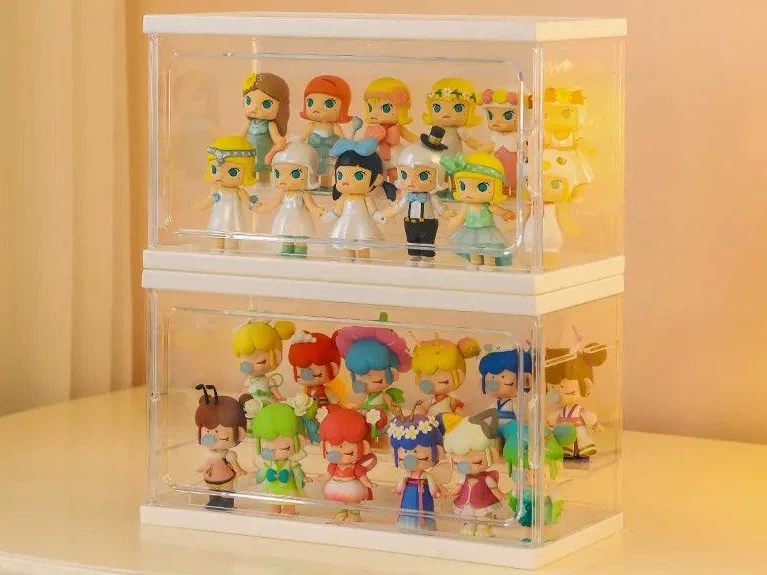
Best Acrylic Display Cases forAnime Collections
Protect and showcase your valuable anime merchandise with these top-rated display solutions.
How Laser EngravingTechnology Works
A deep dive into the science and technology behind laser engraving on various materials.

The Rise of Custom AnimeMerchandise
Exploring how fan-made and custom merchandise has changed the anime industry landscape.
FAQ About Laser Engraved Anime Acrylic Gifts
How much do custom laser engraved acrylic pieces cost?
Prices typically range from $15 for small simple designs to $80+ for large detailed pieces. Quality varies significantly-cheaper options often have visible defects while premium creators use better materials and more precise engraving depths.
Are laser engraved acrylic gifts better than anime figures?
They serve different purposes. Acrylic standees are more affordable ($15-80 vs $120-300 for figures), take up less space, and can be fully customized. Figures offer three-dimensional detail but require dedicated display space.
How long do LED acrylic stands last?
The acrylic itself lasts indefinitely if undamaged. LED bases typically last 20,000-50,000 hours of use. Most bases use replaceable LED strips, so they're effectively permanent with minor maintenance.
Is buying fan-made anime merchandise legal?
Most unofficial merchandise exists in a legal gray area. Japanese copyright law technically prohibits it, but enforcement is inconsistent. Some companies issue cease-and-desists while others tolerate fan creators. Purchase at your own discretion.


