


Last year we shipped 1,200 magnetic acrylic frames to a convenience store chain operating 180 locations across Jiangsu and Zhejiang provinces. Their ops team had calculated that monthly promotional swaps were consuming 45 minutes per store when factoring in the old clip-frame disassembly, content alignment, and reassembly. Six weeks after rollout, they came back with revised numbers: the same task now took under eight minutes total per location. The difference wasn't our product being revolutionary-it was eliminating the mechanical steps that ate time in the first place.
That project taught us something about how B2B buyers actually evaluate magnetic sign holders for retail. The conversation rarely starts with "tell me about your acrylic quality." It starts with a operational pain point, usually around labor efficiency or display consistency across multiple sites. The product specs matter, but they matter in service of solving a workflow problem.

The Real Cost Equation Behind Quick-Change Signage
Procurement teams often benchmark magnetic acrylic display frames against traditional alternatives using unit price alone. A standard metal clip frame runs $5-12; our magnetic acrylic equivalent sits at $15-28 depending on size and customization. On paper, we're more expensive. In practice, the math flips within the first year for any operation running monthly content rotations.

Here's why. Traditional frames fail in predictable ways that don't appear on purchase orders. The spring tension in backing clips degrades after roughly 80-100 cycles-we've tracked this across returns and warranty claims. Once tension drops, content slips. Once content slips, stores either tolerate the inconsistency or replace the entire frame. Neither outcome is what brand teams want. The hidden replacement cycle adds 15-20% annually to what looked like a cheaper upfront buy.
Material Selection: What Actually Matters for Long-Term Performance
Cast versus extruded acrylic is the first fork in supplier evaluation, and it's the one most buyers skip because the difference isn't obvious at unboxing. Both look clear. Both feel solid. The divergence shows up 18-36 months into service, particularly in window or high-light environments.
Cast PMMA holds 92%+ light transmission and resists UV yellowing for a decade or longer when properly stabilized. Extruded runs cheaper by 20-30% at production but starts showing haze or yellowing around year three in sun-exposed applications. We learned this the hard way on an early hotel project-lobby displays installed in 2019 needed replacement by late 2021 because the sourced material was extruded from a supplier who didn't disclose it clearly.

Now we specify Chi Mei or equivalent Tier-1 PMMA origin on every order confirmation. If you're evaluating suppliers, ask for the SGS or equivalent materials certification. Anyone hesitant to provide it is probably running mixed or recycled feedstock.
The magnet system is the second critical checkpoint. Per IEC 60404-8-1 specifications for permanent magnet materials, neodymium grades in the N35-N42 range deliver optimal energy density for display applications without creating separation difficulty. We standardized on N38 after testing found N42 and above made panel separation awkward for store staff-strong enough that you'd see fingernail marks on acrylic edges from prying. Surface field strength above 450 Gauss ensures vertical mounting stability. Below that threshold, A4 and larger content tends to drift downward over weeks.
Watch for ferrite substitution in budget products. Ferrite magnets cost half as much but deliver roughly one-tenth the holding force. They work acceptably for small countertop displays; they fail for anything wall-mounted above postcard size.
Sample Evaluation Protocol
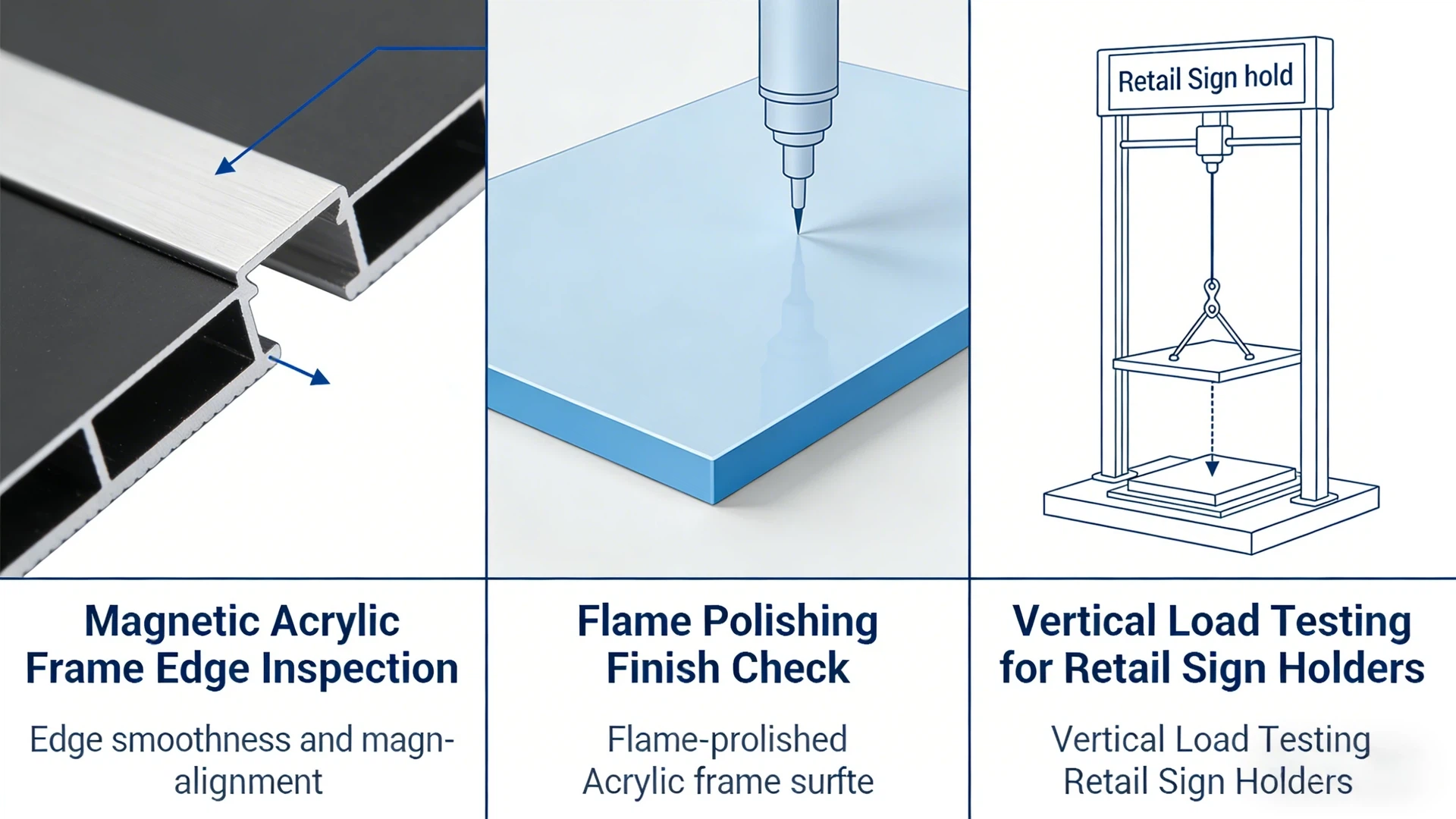
When samples arrive, here's the verification sequence we recommend to clients doing supplier qualification:
When Magnetic Acrylic Isn't the Right Solution
We tell clients upfront about application boundaries because the alternative is a dissatisfied customer and a warranty headache. Three scenarios consistently underperform:
- Outdoor installations without secondary mechanical retention. The magnetic bond handles normal forces fine, but sustained wind loading against an A2 or larger panel can exceed magnet capacity. We had a restaurant client in a coastal location lose three displays during a storm season before we redesigned with backup screw points. If your application is exterior-facing in a high-wind zone, specify the reinforced mounting variant or consider a different product category.
- Environments exceeding 70°C sustained temperature cause progressive demagnetization in standard N-grade neodymium. Commercial kitchens near exhaust vents, certain industrial display positions, and direct greenhouse sunlight can push these limits. The magnets don't fail suddenly-they weaken over months until holding force becomes inadequate.
- Single-placement applications with no content rotation don't justify the cost premium. If you're mounting something once and never updating it, a basic fixed-mount frame costs less and performs identically.

Working With Us
Sample lead time runs 3-5 working days from confirmation. Production orders typically ship within 14-21 days depending on quantity and customization scope. MOQ sits at 50 units for standard sizes; custom dimensions require 100-piece minimum to justify tooling setup.
We include our internal QC checklist with sample shipments-the same verification steps our production team runs before release. That way your receiving team has specific pass/fail criteria rather than subjective judgment calls.
If you're currently comparing suppliers, send your specifications through the inquiry form. We'll respond within one business day with pricing, lead time, and answers to any technical questions. For larger rollouts, we can arrange a factory video walkthrough showing material sourcing, fabrication process, and QC protocols.


